



The best refurbished iMac to buy in 2026 is the 24-inch M1 (2021) for value and the 24-inch M3 (2023) for future-proofing. The M1 delivers full Apple Silicon performance and macOS support for well under new-price money, starting around $569 refurbished. Buyers who want a large screen without paying Apple Silicon prices can still find the 27-inch 5K Retina Intel iMac from roughly $228, though it runs the last Intel-supported macOS. We ranked every refurbished iMac generation by real-time pricing across Back Market, Amazon Renewed, and Apple Certified Refurbished to find the best value at every budget.
According to RefurbMe's tracking, a new iMac reaches the refurbished market a median of 91 days after Apple's release (Time-to-Refurb, as of July 2026), so buyers typically wait about three months for the first refurbished units of a generation to appear. Time-to-Refurb is the median number of days from Apple's release date to the first time RefurbMe records a model in stock refurbished. Across every iMac model RefurbMe has ever tracked, the median Refurb Discount versus the original Apple price is about 89% (as of July 2026), though that family median is skewed high by legacy 2010-era models and does not mean a current iMac sells for 89% off. See the live figures on RefurbMe's iMac stats page.
Quick verdict: the best refurbished iMac by budget
The right refurbished iMac depends on your screen-size needs and how long you plan to keep it. Apple Silicon models (M1, M3, M4) are the future-proof choice; Intel models are the budget big-screen play.
| Model | Best for | Chip | Screen | Refurbished from |
| 24-inch iMac M1 (2021) | Best value | M1 | 24" 4.5K | |
| 24-inch iMac M3 (2023) | Most future-proof | M3 | 24" 4.5K | |
| 27-inch iMac 5K (Intel) | Big screen on a budget | Intel | 27" 5K | |
| 21.5-inch iMac (Intel) | Cheapest all-in-one | Intel | 21.5" |
Prices update in real time from certified refurbishers with warranty, shipping, and return policies you can compare side by side. For the full release history, see every iMac release date and generation.
1. 24-inch iMac M1 (2021): best value
The 24-inch M1 iMac is the best refurbished iMac deal in 2026. Apple's first Apple Silicon all-in-one launched in spring 2021 with a 4.5K Retina display, a slim aluminum body in seven colors, and the same M1 chip that reset expectations for the MacBook Air.
Five years on, the M1 still runs the latest macOS, supports the full range of everyday apps, and handles web work, office tasks, photo editing, and light video without strain. Refurbished units start around $569, a steep drop from the $1,299 launch price. For most home and office buyers, this is the sweet spot: proven Apple Silicon performance at the lowest entry price in the lineup.
The one caveat is memory. The base model ships with 8GB of unified memory soldered to the board, so it cannot be upgraded later. Heavy multitaskers should hunt for a refurbished 16GB configuration up front.
2. 24-inch iMac M3 (2023): most future-proof
The 24-inch M3 iMac is the pick for buyers who want the longest support runway. Released in November 2023, it pairs the same colorful 4.5K design with the faster M3 chip, hardware-accelerated ray tracing, and a stronger Neural Engine for Apple Intelligence tasks.
Refurbished M3 units start around $749. That premium over the M1 buys roughly two extra years of chip generation, which matters if you plan to keep the machine into the 2030s. The M3 handles 4K video edits, large photo libraries, and demanding creative apps more comfortably than the M1.
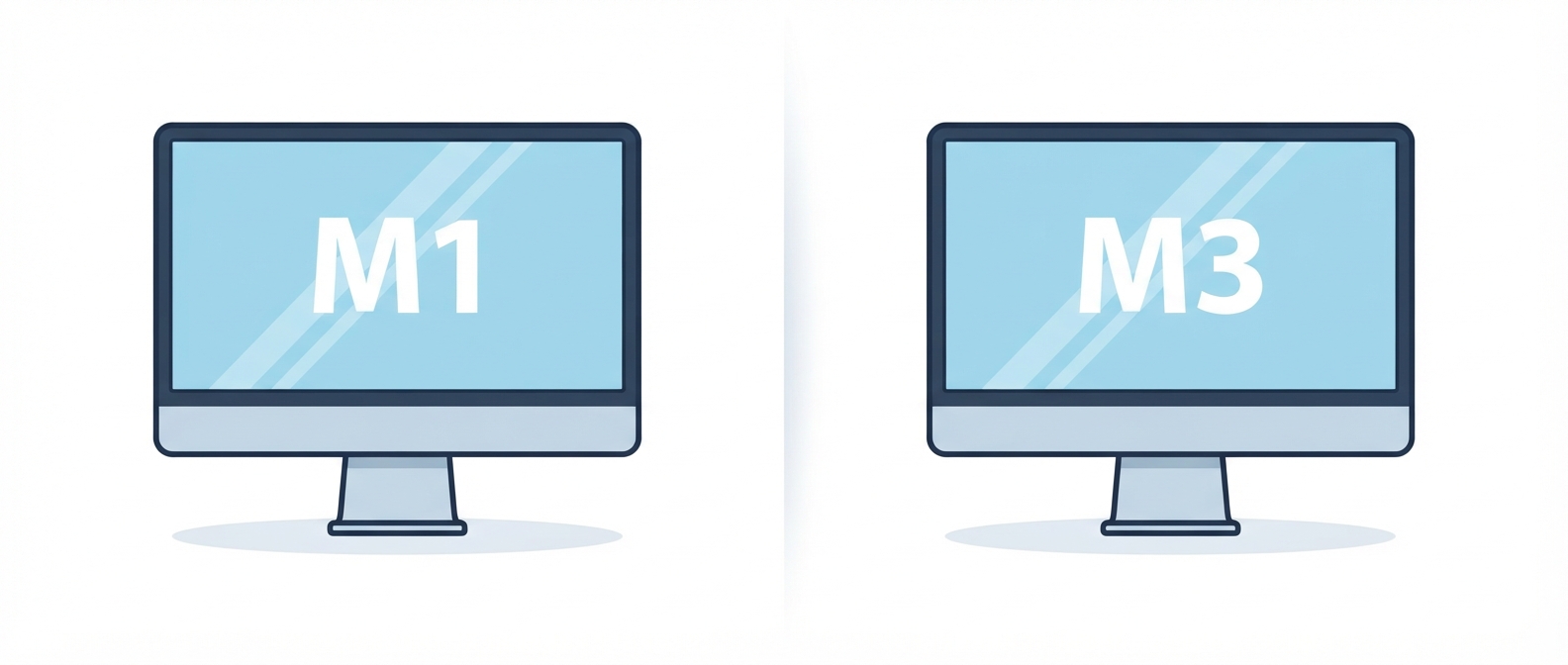
For a buyer choosing between the two, the math is simple: pick the M1 to save money now, or the M3 to stretch the useful life. Both run current macOS and Apple Intelligence, so neither is a compromise on software.
3. 24-inch iMac M4 (2024): the current model
The 24-inch M4 iMac is the newest generation, announced October 28, 2024 and available November 8, 2024. It adds the M4 chip, a nano-texture glass option, and a center-stage camera, and it ships with more base memory than earlier models.
As of July 2026, refurbished M4 iMacs are scarce. That fits RefurbMe's data: with a 91-day median Time-to-Refurb and a machine barely 18 months old, only a thin supply has entered the certified channel, and prices sit close to new. Most buyers get better value from the M1 or M3 today. If you specifically want the current model, track it with a product availability alert so you are notified the moment refurbished stock lands.
4. 27-inch iMac 5K Retina (Intel): big screen on a budget
The 27-inch 5K Retina iMac is the cheapest way to put a large, sharp all-in-one on your desk. Intel-based 2015 to 2020 models are widely available refurbished, ranging from roughly $228 to $390 depending on year, storage, and memory. No Apple Silicon iMac offers a screen this large, which keeps demand alive despite the older chips.
The trade-off is the software horizon. macOS Tahoe (macOS 26) is the final macOS release to support Intel Macs, and it covers the 27-inch 5K models through 2020. After Tahoe, these machines stop receiving major macOS updates, though they will keep working and receiving security patches for a while.
Buy a 27-inch Intel iMac if you want maximum screen for minimum money and can live with a fixed software ceiling. Look for a 2019 or 2020 5K model with an SSD (not a Fusion Drive) for the smoothest experience. For everyone else, an Apple Silicon 24-inch is the more durable choice.
5. 21.5-inch iMac (Intel): cheapest all-in-one
The 21.5-inch Intel iMac is the entry point to the refurbished iMac catalogue, with older 2013 to 2017 models starting around $159. It is a genuine bargain for a basic desktop: web browsing, email, documents, and streaming all run fine on the better-specified units.
Two rules keep this from being a false economy. First, avoid Fusion Drive and spinning-disk models; insist on an SSD configuration, because a mechanical drive makes even a light machine feel slow. Second, treat these as short-horizon buys, since the same macOS Tahoe support ceiling applies and the smaller non-Retina panels on the cheapest units show their age. If the price gap to a 24-inch M1 is small, spend up for Apple Silicon.
How much you save on a refurbished iMac
Refurbished iMacs deliver some of the deepest discounts in Apple's lineup because the desktop turns over more slowly than laptops and phones. Across every iMac model RefurbMe tracks, the median Refurb Discount versus the original Apple price is about 89% (as of July 2026), a figure inflated by legacy 2010-era units still in circulation. That family median is a longevity signal, not a promise that a current model is 89% off.
For a realistic read on a specific generation, compare the live refurbished price to Apple's original list price. The M1 iMac launched at $1,299 and sells refurbished from around $569, roughly 55% off. The 27-inch 5K Intel iMac launched near $1,999 and sells from about $228, an 88% drop that reflects its older Intel silicon. The newer the chip, the smaller the discount, which is why the M4 is not yet a value pick.
Where to buy a refurbished iMac
Where you buy matters as much as which model you pick. RefurbMe compares all major refurbishers so you can see grade, warranty, and price in one place.
Back Market is the largest marketplace of certified refurbishers and typically carries the widest iMac selection with a 12-month warranty and a 30-day return window. It is the first place to check for 24-inch M1 and M3 stock. Amazon Renewed offers a similar certified program with a 90-day guarantee and is worth comparing on price for the same configuration. Specialist sellers such as Mac of All Trades hold deep stock of older 27-inch and 21.5-inch Intel iMacs that the big marketplaces often skip.
For maximum peace of mind, Apple Certified Refurbished rebuilds each unit with a new outer shell and battery where applicable and includes a full one-year warranty, though Apple rarely lists older iMac generations and its prices sit at the top of the range. eBay Refurbished, eBay's vetted certified-refurbished program (distinct from its open marketplace), is another certified source with graded conditions and returns. Whichever seller you choose, compare warranty and return terms side by side before you buy.
Apple Silicon vs Intel: which iMac to choose
The core decision is chip architecture. Apple Silicon iMacs (M1, M3, M4) run faster, cooler, and quieter than any Intel iMac, and they are guaranteed years more macOS support. Intel iMacs win only on screen size (the 27-inch 5K) and rock-bottom price.
macOS Tahoe (macOS 26) is the last release to support Intel Macs, so a 27-inch 5K Intel iMac bought today will stop getting new macOS versions after Tahoe. An M1 iMac, by contrast, is on the Apple Silicon track that Apple keeps updating for six or more years. If you plan to keep the machine past 2028, buy Apple Silicon.
One shared limit applies to every modern iMac: memory and storage are soldered on Apple Silicon models and cannot be upgraded after purchase. Configure enough RAM and SSD at the point of sale. For a fuller picture of Mac value over time, see whether refurbished is worth it versus new or used.
Pre-purchase checklist for a refurbished iMac
A few checks separate a great refurbished iMac from a regret. Run through these before you buy.
- Confirm the display is flawless. The iMac is defined by its screen, so verify the listing grades cover no dead pixels, burn-in, or backlight bleed.
- Insist on an SSD, not a Fusion Drive. On Intel models especially, a mechanical or Fusion drive is the single biggest drag on speed.
- Check the memory configuration. Apple Silicon RAM is soldered; buy the capacity you need up front, ideally 16GB.
- Verify Activation Lock is cleared. The seller should confirm the iMac is signed out of the previous owner's Apple Account.
- Read the warranty and return window. A 12-month warranty and a 30-day return window are the benchmark from certified sellers.
- Match the macOS horizon to your plan. Intel iMacs top out at macOS Tahoe; buy Apple Silicon if you want years of updates.
Should you wait for the M5 iMac?
An M5 iMac refresh is expected in late 2026 or 2027, following Apple's roughly annual chip cadence. A new generation reliably pushes older refurbished stock down, so an M5 launch would likely nudge M4, M3, and M1 refurbished prices lower.
For most buyers, waiting is not worth it. The M1 and M3 are already excellent values today, and a new M5 iMac will start near full retail with a 91-day median wait before the first refurbished units appear. If you need an iMac now, buy the M1 or M3; if you can wait six months to a year and want the newest silicon, set a price alert and let the refresh do the work.
Buying refurbished also keeps working electronics out of landfills. You get a cheaper Mac; the planet gets a break.
Head to RefurbMe to compare live refurbished iMac prices, and browse refurbished MacBooks if a laptop suits you better.
Related: Best iMac Accessories | 7 Best Refurbished MacBooks | Where to Buy a Refurbished Mac
FAQ
First published: Jul 1, 2026